






 Strains
 Guides
 Outils
 Support





Résolution des Problèmes
Votre kit de culture de champignons ne produit pas de champignons ? Voici comment identifier le problème et y remédier
Un kit de culture qui ne passe pas en phase de fructification est la préoccupation la plus courante que nous entendons de la part des cultivateurs, et dans la grande majorité des cas, le kit fonctionne parfaitement. La plupart des kits “ bloqués ” sont simplement en avance, ou se trouvent dans des conditions légèrement décalées sur l’une des quatre variables. Ce guide vous explique l’ordre exact de diagnostic qu’un cultivateur expérimenté suivrait : vérifiez d’abord le moment de la culture, puis examinez les quatre conditions de fructification, et enfin éliminez les causes suivantes : contamination, et ce n'est qu'ensuite qu'il faut essayer de remettre le kit en marche.
Suivez les étapes dans l'ordre. Ne passez pas directement à la “ réactivation ” d'un kit qui n'a en réalité que trois jours d'avance.
Tout d'abord, est-ce que votre kit est vraiment coincé ?
Avant de changer quoi que ce soit, assurez-vous que votre culture est bel et bien en retard et non pas simplement en avance. La patience est la solution la plus négligée en matière de culture.
Une fois que vous avez mis en route un kit dans de bonnes conditions, les premiers bourgeons (minuscules primordia de champignons, qui se présentent souvent sous la forme de petites bosses blanches) apparaissent généralement au bout de 7 à 14 jours environ, selon la souche et les conditions de votre pièce. Une pièce plus froide retarde cette apparition. Si aucun bourgeon n'est apparu au bout de 5 jours, ce n'est pas grave ; c'est tout à fait normal.
Voici un modèle mental approximatif :
- Ponctuel / paresseux : Il n'y a pas encore de bourgeons, mais vous êtes toujours dans la fourchette d'environ une semaine par rapport à la période habituelle d'apparition des premiers bourgeons pour votre variété. Continuez à suivre les instructions et vérifiez quotidiennement. Ne faites rien d'autre.
- Mécontent : Aucune épi n'apparaît jusqu'à environ 14 jours après la période prévue. Il s'agit presque toujours d'un problème lié aux conditions (température, aération ou lumière). Corrigez les conditions ci-dessous.
- Le sommeil : aucun broche ne doit présenter un retard supérieur à environ trois semaines par rapport à la période prévue, et aucune contamination visible ne doit être constatée. C'est dans ce cas qu'une procédure de réactivation est justifiée.
Si vous êtes toujours dans la fenêtre « lazy », arrêtez-vous ici et attendez. Sinon, continuez.
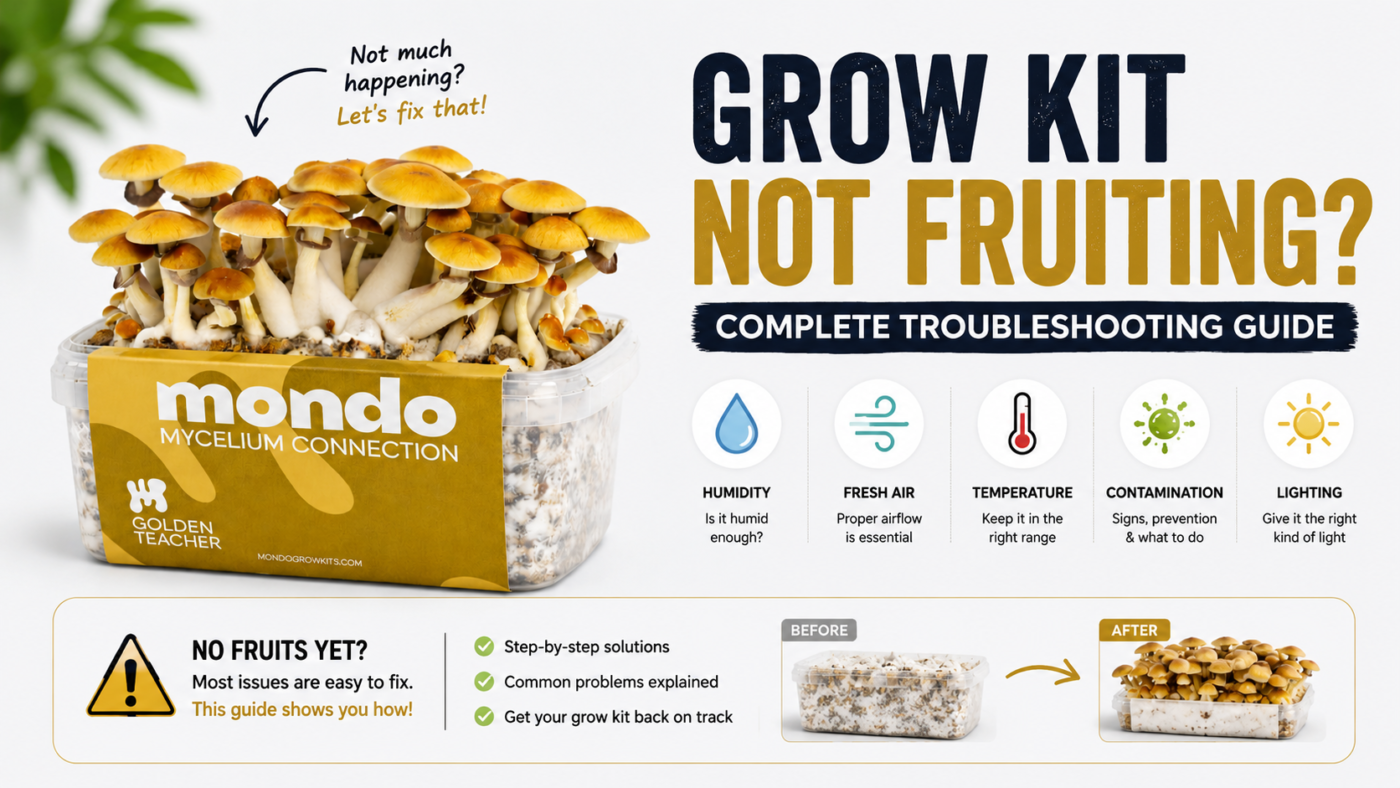
Les quatre conditions indispensables à la fructification de tout kit
La fructification est déclenchée par une combinaison de facteurs, et non par un seul. Lorsqu'un kit entièrement colonisé (dont le substrat est recouvert de mycélium blanc) ne produit pas de corps fructifères, la cause est presque toujours l'une de ces quatre. Vérifiez-les dans cet ordre.
1. Température
C'est la raison la plus courante pour laquelle un kit colonisé cesse de se développer. La plupart des kits de Psilocybe cubensis produisent le mieux leurs fruits à une température comprise entre environ 20 et 28 °C, la température idéale se situant autour de 23 °C. En dessous d’environ 18 °C, le mycélium ralentit considérablement ou entre en dormance. Des températures trop élevées peuvent favoriser la prolifération bactérienne et accélérer le dessèchement du substrat.
Mesurez la température aussi près que possible du kit, et non ailleurs dans la pièce. Si vous utilisez un tapis chauffant, ne posez jamais le kit directement dessus. Prévoyez plutôt une couche intermédiaire, comme du carton, du liège ou un petit support, car le contact direct peut entraîner une surchauffe de la base du substrat.
2. Renouvellement d'air (FAE)
Le mycélium consomme de l'oxygène et rejette du dioxyde de carbone (CO₂), tout comme les êtres humains. Des taux élevés de CO₂ constituent l'une des causes les plus courantes pour lesquelles un kit ne parvient pas à se développer ou produit des champignons longs et fins aux chapeaux minuscules. Si vos champignons poussent en hauteur et sont filiformes, cela est généralement dû à un manque d'air frais.
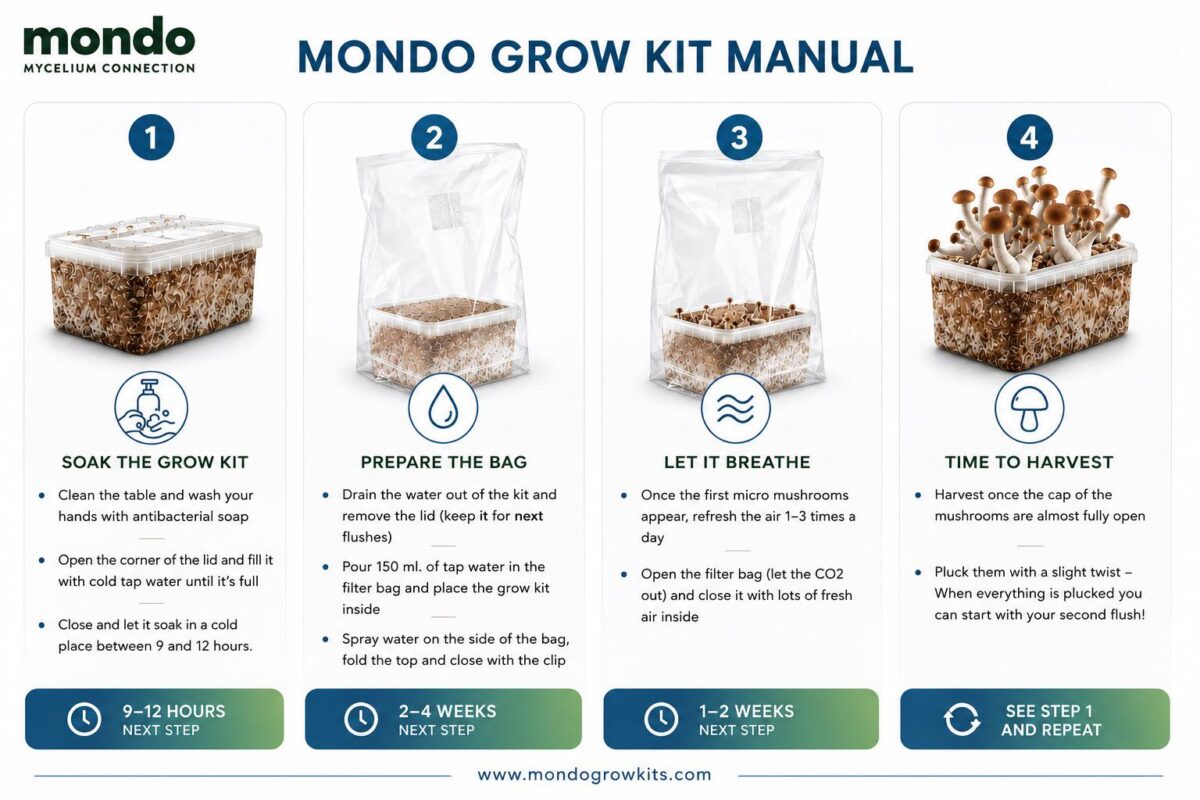
La solution consiste à améliorer la circulation de l'air sans assécher le kit de culture. N'ouvrez le sac de culture que conformément aux instructions du fabricant et continuez à utiliser le sac d'origine fourni avec le kit, car il est conçu pour assurer un équilibre entre l'humidité et les échanges gazeux. Ouvrir le sac trop souvent ou trop longtemps peut assécher la surface et augmenter le risque de contamination. L'air frais et l'humidité doivent rester en équilibre.
3. Humidité
Le mycélium absorbe l'humidité de l'air ambiant, et pas seulement celle du substrat. Si la surface s'assèche, les bourgeons peuvent rapidement dépérir. L'objectif est de maintenir un microclimat humide sans pour autant laisser l'eau s'accumuler sur le substrat. La condensation à l'intérieur du sac de culture est normale et constitue généralement un bon signe.
Si la surface semble sèche, créez une petite tente d'humidification en recouvrant le kit d'un sac en plastique transparent muni de quelques petits trous d'aération. Vaporisez de l'eau à l'intérieur du sac plutôt que de pulvériser directement sur le substrat. Une légère vaporisation deux à trois fois par jour suffit généralement. Ne laissez jamais d'eau stagner à la surface, car cela affaiblit le substrat et favorise la contamination.
4. Lumière
Bien que les champignons ne pratiquent pas la photosynthèse, les champignons comestibles utilisent la lumière comme signal pour s'orienter et fructifier. Placez le kit de culture à la lumière indirecte du soleil et respectez un cycle jour-nuit normal. Une étagère ou une table dans une pièce bénéficiant d'un éclairage naturel est l'idéal.
Évitez l'exposition directe au soleil, qui peut entraîner une surchauffe du kit, assécher le substrat et provoquer d'importantes variations de température. Il convient également d'éviter l'obscurité totale, car elle empêche l'un des déclencheurs environnementaux nécessaires à la fructification.
Comprendre votre kit : mycélium sain ou contamination ?
Avant d'essayer de redonner vie à un kit de culture, assurez-vous qu'il n'y a pas de contamination. Un kit contaminé ne peut pas être récupéré et ne doit pas être réutilisé. Heureusement, de nombreux cultivateurs confondent souvent un mycélium sain avec de la moisissure.
- Excroissances blanches, duveteuses ou filiformes : Il s'agit là d'un mycélium sain. Il peut ressembler à du coton ou prendre un aspect duveteux, semblable à celui d'un chou-fleur, peu avant la formation des épines.
- Gouttelettes de liquide jaunes, ambrées ou brunes : Il s'agit de métabolites, parfois appelés “ pipi de champignon ”. Ils sont inoffensifs et indiquent souvent que le substrat est arrivé à maturité et s'apprête à produire des fruits.
- Taches bleues, vertes, noires ou grises : La présence d'une prolifération colorée et duveteuse est généralement le signe d'une contamination par des moisissures. Un kit présentant des moisissures vertes ou noires bien développées, ou dégageant une odeur aigre, de moisi ou désagréable, doit être jeté immédiatement. Contactez votre fournisseur pour obtenir de l'aide.
Une règle empirique simple : si le substrat est blanc et inodore, il est généralement sain, tandis qu’une prolifération colorée ou des odeurs désagréables indiquent une contamination. En cas de doute, prenez une photo nette et contactez le service d’assistance avant de manipuler davantage le kit, car le fait de remuer un substrat contaminé peut propager spores.
Comment réveiller un kit endormi
N'essayez ces méthodes que si votre kit de culture se trouve réellement en phase de “ dormance ” (bien au-delà de la période prévue pour la formation des bourgeons) et si vous vous êtes assuré qu'il n'y a aucune contamination. Testez une technique à la fois, laissez-lui plusieurs jours pour agir, et ne passez à la méthode suivante que si cela s'avère nécessaire.
-
Vérifiez à nouveau les quatre conditions nécessaires à la fructification.
La température, l'humidité, l'aération et la lumière sont à l'origine de la plupart des retards observés dans les kits de culture. Corrigez ces problèmes et attendez trois à quatre jours avant de prendre d'autres mesures. -
Choc thermique.
Une baisse temporaire de la température peut parfois déclencher la fructification. Placez le kit de culture fermé au réfrigérateur (jamais au congélateur) pendant environ 12 heures, puis remettez-le dans des conditions normales de fructification. Cela reproduit les variations saisonnières de température qui déclenchent souvent la fructification dans la nature. -
Améliorer le renouvellement de l'air.
Effectuez chaque jour quelques renouvellements d'air contrôlés supplémentaires, en suivant les instructions fournies avec votre kit de culture. Cela permet d'éliminer le CO₂ accumulé et indique au mycélium que les conditions sont propices à la fructification. -
Réhydratez le substrat si cela est possible.
Certains kits de culture de type « gâteau » réagissent bien à une réhydratation effectuée avec soin. Ne procédez à cette étape que si elle est expressément recommandée dans les instructions du fabricant. Utilisez toujours de l'eau propre et respectez les règles d'hygiène, car la réhydratation augmente le risque de contamination.
Faites preuve de patience après avoir mis en œuvre une méthode de rétablissement. Une fois que la formation des pieds commence, la croissance des champignons peut s'accélérer rapidement, et même un kit mis en place tardivement peut encore donner une excellente récolte.
Durée de la fermentation : pourquoi certains kits prennent plus de temps
Toutes les souches de champignons ne se développent pas au même rythme. Une souche à croissance plus lente est souvent considérée à tort comme un kit de culture raté, alors qu'elle suit simplement son cycle naturel.
- Souches standard de Psilocybe cubensis tels que le Golden Teacher, le B+ et le « Mexican » sont généralement adaptés aux débutants et se clôturent généralement dans les délais habituels.
- Variétés hybrides Les variétés telles que la Jack Frost et celles présentant des caractéristiques génétiques similaires nécessitent souvent 7 à 14 jours supplémentaires avant la fixation des pieds par rapport aux variétés standard de cubensis.
- Génétique Penis Envy sont réputées pour leur développement plus lent et peuvent parfois mettre quatre semaines, voire plus, avant de produire des épingles.
Si vous cultivez une variété à croissance plus lente, adaptez vos attentes en conséquence avant de conclure qu’il y a un problème avec le kit de culture.
Quand faut-il s'arrêter et demander un remplacement ?
Dans certains cas, le problème provient du kit de culture lui-même plutôt que des conditions de culture. Contactez votre fournisseur si l'une des situations suivantes se présente :
- Le kit est arrivé avec des traces visibles de moisissure verte, noire ou d'une autre couleur.
- Le substrat dégage une odeur aigre, de moisi ou désagréable.
- Le substrat n'a jamais été colonisé et ne présente que peu, voire aucune croissance de mycélium blanc.
- Le kit reste inactif bien après la période de fructification prévue, malgré des conditions adéquates et des tentatives de relance.
Veillez à avoir à portée de main les informations relatives à votre commande ainsi que des photos nettes lorsque vous contactez le service client, car la plupart des fournisseurs évaluent les problèmes liés aux kits de culture à partir d'images. Si vous avez acheté votre kit auprès de Kits de culture Mondo, notre équipe d'assistance pourra examiner vos photos et vous aider à déterminer la meilleure marche à suivre.
Foire aux questions
Dans de bonnes conditions, les premières tiges apparaissent généralement au bout de 7 à 14 jours environ, selon la souche et la température ambiante. Les pièces plus froides et les souches à croissance plus lente retardent ce processus ; il est donc normal qu’un kit n’ait pas encore produit de tiges au bout de la première semaine.
Dans le cas d'un kit entièrement colonisé, la cause la plus fréquente est une température trop basse, suivie d'un apport d'air frais insuffisant. Vérifiez que la température du kit se situe entre 20 et 28 °C environ et que le renouvellement d'air est contrôlé avant d'essayer quoi que ce soit d'autre.
C'est le signe classique d'un excès de CO₂ et d'un renouvellement insuffisant de l'air frais. Assurez un débit d'air plus régulé au kit, comme indiqué dans le mode d'emploi, sans le laisser se dessécher.
Presque jamais. Les excroissances blanches, duveteuses ou filiformes correspondent à un mycélium sain. Seules les taches colorées (bleues, vertes, noires ou grises) ou une odeur nauséabonde indiquent une contamination.
Non. Les gouttelettes de couleur jaune à brune sont des métabolites, parfois appelés « pipi de champignon », et sont inoffensives. Elles indiquent souvent que le bloc est arrivé à maturité et prêt à produire des fruits.
Un kit présentant des traces de moisissure verte ou noire ne peut pas être sauvé de manière fiable et doit être jeté, et non réutilisé. La meilleure approche consiste à prévenir ce problème en veillant à une manipulation propre et à des conditions de conservation adéquates.
Uniquement selon les instructions fournies avec votre kit. Le sachet fourni est conçu pour réguler l'humidité et les échanges gazeux ; l'ouvrir trop souvent ou le laisser ouvert trop longtemps assèche la surface et augmente le risque de contamination.