







 Strains
 Guides
 Outils
 Support





Guides de culture
Combien de temps faut-il pour faire pousser des champignons magiques ?
One of the hardest parts of growing mushrooms for the first time is simply waiting. You activate your grow kit, place it in the right conditions and then, for a while, not much seems to happen.
That can feel strange if you expected to see visible changes straight away. In practice, the first part of the grow is often the quietest. Then the first tiny pins appear, and suddenly the whole process starts moving much faster.
So, how long does it take to grow magic mushrooms? With a ready-to-grow kit, the first harvest usually takes a few weeks from activation. There is no exact day that applies to every kit, though. Genetics, temperature, humidity, fresh air and the overall condition of the mycelium can all affect the timing.
At Mondo, we regularly hear from growers who think something has gone wrong because their kit is a few days behind a timeline they found online. Most of the time, nothing is wrong at all. Two kits started on the same day can develop at slightly different speeds and still both produce a healthy flush.
How Long Does a Mushroom Grow Kit Take?
The most useful way to look at the timing is not as one fixed number, but as a series of stages.
After activation, the mycelium first needs time to adjust to fruiting conditions. During this stage, the surface of the kit may look almost unchanged from one day to the next. That does not mean the grow has stopped.
Once the first pins appear, the pace changes completely. Those tiny mushroom formations can develop surprisingly quickly, and this is usually the point where daily checks become much more useful.
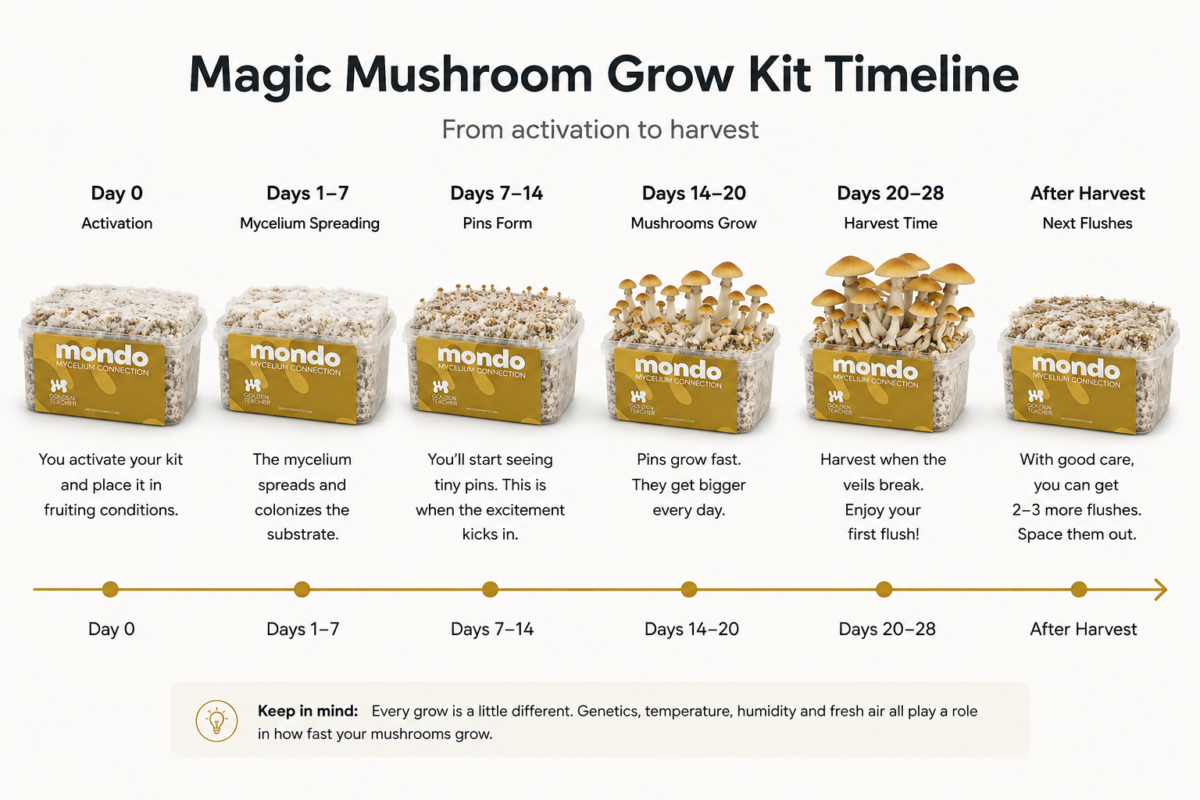
A typical first grow follows roughly this sequence:
- Activation: the kit is prepared and placed into fruiting conditions.
- Adjustment period: the mycelium settles into the new environment while little may be visible on the surface.
- Pinning: the first tiny mushroom formations begin to appear.
- Rapid growth: the pins develop into recognizable mushrooms over the following days.
- Harvest: the mushrooms reach the right stage for picking.
- Next flush: after harvesting, the kit can usually be prepared for another round.
The exact timing of each stage varies. Some strains are naturally faster than others, while environmental conditions can speed things up or slow them down.
A slower kit is therefore not automatically a bad kit. What matters more is whether the mycelium still looks healthy and whether the conditions remain stable.
What Does a Normal Grow Timeline Look Like?
The beginning of a grow usually requires more patience than action. It is tempting to start changing things when you have been looking at the same surface for several days, but unnecessary adjustments can make the growing conditions less stable.
Once pinning starts, the process becomes much easier to follow visually. Small pins can turn into mature mushrooms within a relatively short period, which is why the final part of a flush often feels much faster than the beginning.
The timeline below gives you a visual reference for the main stages of a kit de culture de champignons, from activation to harvest. Use it as a guide rather than a deadline. Your own kit does not need to reach every stage on exactly the same day.
Why Is My Grow Kit Taking Longer?
If your grow kit is developing more slowly than expected, that does not automatically mean something is wrong.
Timing can vary for several reasons. The most common are temperature, humidity, airflow and strain genetics. Even small differences in room conditions can affect how quickly the first pins appear.
It is also worth remembering that the first visible stage is not always the first biological stage. Mycelium can still be active even when the surface appears unchanged.
Before changing anything, check whether the growing conditions are stable and whether the mycelium still looks healthy. Constantly adjusting the setup can sometimes delay progress rather than improve it.
How Long Until the First Pins Appear?
For many kits de culture, the first pins appear within roughly the first one to two weeks after activation. Some kits show signs earlier, while others take longer.
If you are only a few days into the grow, there is usually no reason to intervene. This is one of the stages where patience matters most.
Once pins appear, you have a much clearer indication that the kit has entered the fruiting stage.
How Fast Do Mushrooms Grow After Pinning?
This is where the grow often becomes much more exciting.
After the first pins appear, mushrooms can develop quickly. What starts as a tiny pin can become a mature mushroom in just several days under suitable conditions.
At this point, it is useful to check the grow once or twice a day. The final part of the growth cycle can move much faster than the first half.
This is also the stage where harvesting at the right moment becomes important, especially once the caps begin to open and the veil underneath starts to stretch.
How Long Until the First Harvest?
For a typical ready-to-grow mushroom kit, the first harvest usually takes a few weeks from activation.
That does not mean every kit should be harvested on the same day. Some strains are naturally faster, while others develop more slowly but can still produce a healthy flush.
The better question is not “What day should I harvest?” but “What stage are the mushrooms in?”
Visual development is more reliable than counting days alone.
Track Your Own Grow
If you have already started your kit, you do not need to calculate the timeline yourself.
Enter your start date in the Mondo Grow Tracker below. It will show you the stage your grow is likely to be in and what you can roughly expect next.
Sachez exactement où se trouve votre culture
Définissez votre date de début une seule fois, puis ajoutez le lien vers votre suivi personnel à vos favoris : il vous indiquera toujours l'étape en cours sans que vous ayez à la calculer vous-même.
What Can Speed Up or Slow Down Growth?
There are a few factors that have a noticeable effect on the grow timeline.
Température
Stable temperature is more important than constantly trying to make the grow warmer. Conditions that are too cold can slow development, while excessive heat can stress the mycelium.
Humidité
Mushrooms need a humid environment during fruiting, but more moisture is not always better. Too much water can create poor conditions around the substrate.
Fresh Air
Fresh air exchange becomes especially important during fruiting. If carbon dioxide builds up around the mushrooms, growth can become weak or distorted.
Strain Genetics
Some Psilocybe cubensis strains simply grow faster than others. This is one reason why two kits kept in the same room can still develop at different speeds.
When Should You Start to Worry?
A slow grow is not necessarily a failed grow.
It becomes more important to investigate when the kit has shown no progress for an unusually long period, the mycelium changes appearance, or you notice signs such as unusual discoloration or an unpleasant smell.
If the kit looks healthy but is simply not fruiting yet, check the growing conditions first.
For a more detailed diagnosis, use the Guide de dépannage Mondo or read our guide on what to do when a mushroom grow kit is not fruiting.
How Long Between Flushes?
After the first harvest, the substrate needs time to recover before producing another flush.
The next flush usually takes less time to understand because you already know what the kit looks like when it is healthy and progressing normally.
However, later flushes can still vary in speed and size. Each grow kit has a limited amount of water and nutrients available, so later flushes are often smaller than the first.
If you want to understand the full process, including how to prepare the kit again, read our guide on how many flushes you can get from a mushroom grow kit.
The Timeline Is a Guide, Not a Deadline
The main thing to remember is that mushrooms do not follow an exact calendar.
A timeline is useful because it helps you understand what normally happens next. It should not make you think your grow has failed simply because it is a few days behind.
Healthy mycelium, stable conditions and patience matter more than hitting a specific day.
If you are unsure where your grow should be, use the Grow Tracker above and compare the stage of your kit with what you see rather than focusing only on the number of days.
Frequently Asked Questions About Mushroom Grow Time
With a ready-to-grow mushroom kit, the first harvest usually takes a few weeks from activation. The exact timing varies depending on the strain, temperature, humidity, fresh air and the condition of the mycelium.
The first pins often appear within one to two weeks after activation, although some grow kits take longer. A few days of difference is normal and does not necessarily mean something is wrong.
Once pins appear, growth can move surprisingly fast. Small pins can develop into mature mushrooms within several days under suitable fruiting conditions, so it is worth checking your kit daily at this stage.
A slower grow can be caused by genetics, temperature, humidity, fresh air or simply natural variation between kits. If the mycelium looks healthy, a grow taking a little longer than expected is usually not a reason to assume it has failed.
After the first harvest, the mycelium needs time to recover before producing new pins. The timing varies between kits and flushes, so look for new growth rather than expecting the next flush on one specific day.