




 Strains
 Guides
 Tools
 Support






Troubleshooting
Mycelium Overlay: Why a Thick White Layer Stops Your Kit From Pinning
Mycelium overlay is a dense, often leathery mat of white mycelium on the surface of the substrate that keeps growing instead of forming pins. It is not contamination; it is healthy mycelium that has not received a strong enough signal to switch to fruiting. The usual causes are too little fresh air, too much warmth or too little light, and in most cases the kit can still fruit once the conditions change.
What does mycelium overlay look like?
Overlay looks like a thick white blanket on top of the kit. Compared with normal surface mycelium, it:
- is denser and more opaque, sometimes with a felt-like or leathery feel;
- covers the surface evenly instead of showing small knots that become pins;
- keeps getting thicker over several days;
- may turn slightly yellowish or develop small droplets as it ages.
Some fluffy white growth on the surface is normal, especially in the first days after activation. It becomes overlay when it stays fluffy or turns into a mat for a week or more while no pins appear.
Why does mycelium overlay happen?
Overlay happens when the mycelium gets conditions that favor growth over fruiting. Mycelium switches to fruiting when it senses fresh air, light and a slight drop in humidity at the surface. Without those signals it keeps expanding.
| Cause | Why it leads to overlay | What to check |
|---|---|---|
| Too little fresh air | High carbon dioxide keeps the mycelium in growth mode | Is the bag opened at all once pinning should start? |
| Too warm | Warmth favors vegetative growth | Is the kit above 26 to 27 °C? Heat mat set too high? |
| Too dark | Light is one of the fruiting signals | Is the kit in a cupboard or dark corner? |
| Surface too wet | A soggy surface stays covered in aerial mycelium | Standing water on the surface or too much misting? |
| Strain or genetics | Some cultures are more vegetative than others | Does the same strain behave like this in other kits? |
How do you fix mycelium overlay on a grow kit?
Fix overlay by strengthening the fruiting signals, one at a time, before you consider touching the surface.
Products used here
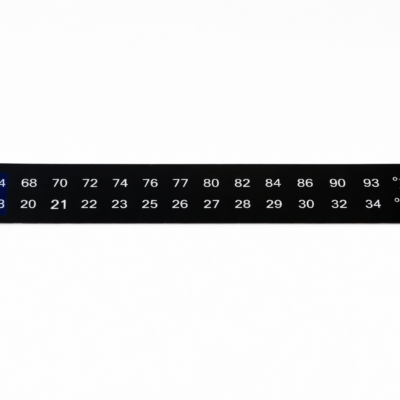
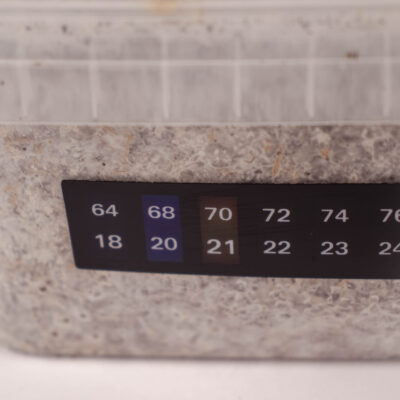
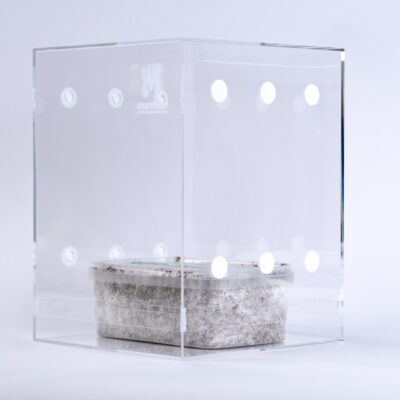

Do not scrape the kit without asking
Some growers scratch or scrape overlay away. On a Mondo grow kit this opens the surface to contamination and can damage the mycelium underneath. Try the conditions first, and contact Mondo support with photos before you touch the surface.
Is overlay the same as mold?
No. Overlay is pure white mushroom mycelium. Mold is usually colored: green, blue-green, black, grey, pink or orange. There is one exception to watch: cobweb mold, which is grey-white, very fine and wispy, grows fast and collapses into a grey film when misted. Overlay is denser and stays white.
Compare with the photos in our guide to contamination if you are unsure. Yellow droplets on aging overlay are usually metabolites, a normal by-product of mycelium under stress, not contamination.
How do you prevent overlay in the next flush?
Prevent overlay by starting the fruiting routine on time and keeping the temperature in range:
- keep the kit in bright, indirect light from activation onward;
- keep it at 23 to 25 °C, not warmer;
- once pins should be forming, follow the fresh-air routine from the manual;
- after a harvest, soak the kit as the manual describes and return it to the same conditions.
Our guide to fruiting conditions covers the balance of light, air and humidity, and our article on a grow kit that is not fruiting goes through the other reasons a kit might not pin.
Fruiting conditions made easier
Every Mondo product comes with a step-by-step manual on our site, and orders ship discreetly with tracking.
Shop grow toolsQuestions about mycelium overlay
It delays pinning and can reduce the first flush, but it does not make the kit unhealthy. Once the conditions change, most kits start pinning.
Yes, for the same reasons. Light, temperature and air exchange are the first things to check. See our guide on how to use a ready-to-grow bag.
Aging mycelium often releases yellowish metabolites. That is usually a stress signal, not contamination. Improve the conditions.
It can, if it pushes the kit above the recommended range. Measure the temperature on the kit and turn the controller down if needed.
Often, yes. Pins can form on or through a thin overlay once the fruiting signals are strong enough.