






 Strains
 Guides
 Tools
 Support


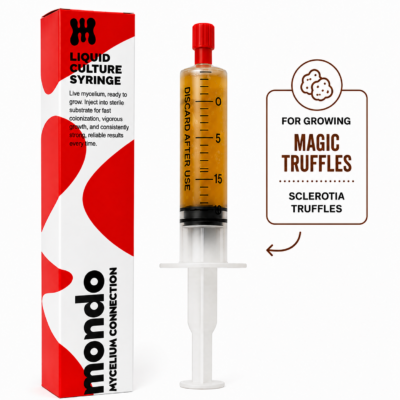
A liquid culture syringe is the fastest way to get a known line of mycelium into a sterile medium. The choice in this section is mainly about species: which fungus do you want to work with?
Which liquid culture do you need?
| You want to work with | Choose | Number of strains |
|---|---|---|
| Psilocybe cubensis, mushrooms above the substrate | Magic mushroom liquid cultures | 21 |
| Truffle-forming species such as P. mexicana and P. tampanensis | Magic truffle liquid cultures | 7 |
| Edible oyster mushroom, Pleurotus ostreatus | Gourmet liquid cultures | 1 |
One name causes confusion: Mexicana exists as a cubensis strain and as the truffle species Psilocybe mexicana. A cubensis culture never forms truffles, so check which category you are in before ordering.
Why liquid culture instead of spores?
- No germination step. The mycelium is already growing, so the first growth is visible sooner.
- More uniform genetics. Each culture comes from one selected line instead of thousands of different spores.
- Less waiting, less exposure. A shorter start leaves less time for contamination to take hold.
The trade-off is shelf life: living mycelium keeps for 2 to 3 months in the fridge, spores keep longer. If you want to compare both, read liquid culture vs spore syringe or browse our spore syringes.
Storage and handling
Keep each syringe in the fridge at 2 to 8 °C from the moment it arrives. Do not freeze it and keep it out of the light. Before use, let it reach room temperature and shake it gently so the mycelium is evenly spread. Work clean: disinfect your hands and surface with the supplied wipes. The liquid culture syringe manual covers the details.
Our liquid cultures are sold for microscopy and educational purposes. Rules differ per country, so check what applies where you live.
Questions about liquid culture syringes
20 ml, with a sterile needle and disinfectant wipes in the pack.
Up to 2 to 3 months in the fridge at 2 to 8 °C.
No. Psilocybe cubensis does not form sclerotia. For truffles you need a culture of a truffle-forming species.