




 Strains
 Guides
 Tools
Tools Support





Comparisons
Liquid Culture vs Spore Syringe: Which One Should You Use?
In the liquid culture vs spore syringe question, the deciding difference is what is inside: a liquid culture syringe contains living mycelium in a nutrient broth, a spore syringe contains dormant spores in sterile water. Liquid culture skips germination, so it usually colonizes faster and more predictably. Spores are slower and less uniform, but they keep longer and give you the full genetic variety of a strain.
What is the difference between a liquid culture and a spore syringe?
A spore syringe is a starting point that still has to come alive, while a liquid culture syringe is already growing. That one difference explains almost everything else in the comparison below.
| Liquid culture syringe | Spore syringe | |
|---|---|---|
| Contents | Living mycelium in a sugar or malt-based nutrient broth | Dormant spores suspended in sterile (demineralized) water |
| What happens after injection | Mycelium starts growing into the substrate straight away | Spores first germinate, then compatible strands have to pair up before strong growth starts |
| Genetics | One selected culture, so results are more uniform | Many genetically different spores, so growth and fruit can vary |
| Speed | Faster start | Slower start |
| Typical fridge life (Mondo guidance) | 6 to 8 months at 2 to 8 °C | 8 to 12 months at 2 to 8 °C |
| Best for | Growers who want a reliable, repeatable result | Collectors, microscopy and growers who want to select their own genetics |
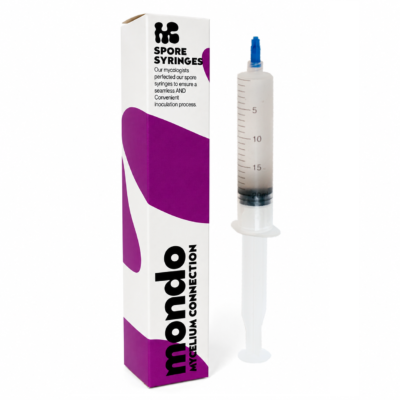
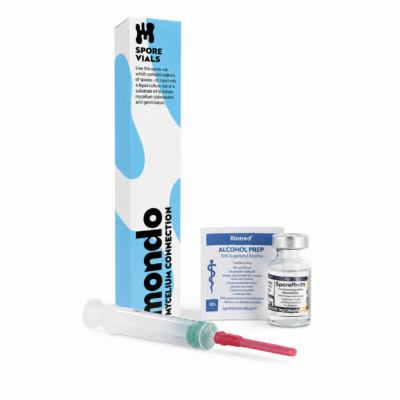
Both Mondo syringes contain 20 ml and come with a sterile needle and alcohol swabs.
Why does liquid culture colonize faster?
Liquid culture colonizes faster because the slowest biological step has already happened before the syringe reaches you. A single mushroom spore cannot produce a fruiting body on its own. It germinates into a thin strand of mycelium, and that strand has to meet and fuse with a compatible strand from another spore. Only then does the vigorous mycelium form that colonizes grain or substrate.
With a liquid culture, that pairing took place in the lab. At Mondo the process starts on Petri dishes, where the cleanest and strongest growing section is selected and transferred into broth. When you inject it, hundreds of small fragments of active mycelium start growing at once.
How much time that saves depends on temperature, substrate and strain. On a warm, stable shelf the head start from liquid culture is usually a matter of days rather than weeks. On a cold windowsill in winter, spores can lag much further behind.
Products used here
✓ In stock
Which syringe carries more contamination risk?
Neither syringe is risk free, but they fail in different ways. The difference is mostly in how easy a problem is to spot.
Spore syringes are made from spore prints. A print is collected from a mushroom cap on foil or paper, which is a clean surface but never a sterile one. A few bacteria or mold spores can travel along with the mushroom spores, and because the water stays clear you cannot see them.
Liquid cultures are grown in a nutrient broth. That broth feeds mycelium, but it would feed bacteria just as well. The upside is that problems usually show: a healthy liquid culture is clear liquid with visible white clumps or strands of mycelium. A culture that has turned cloudy, discolored or smells sour should not go into your substrate.
Check the syringe before you inject
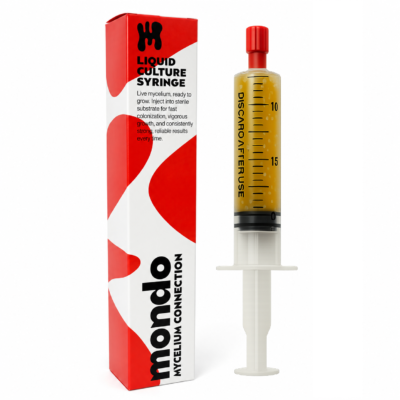
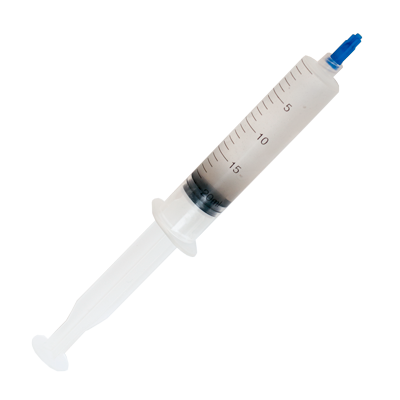
Hold the syringe against a light source. A liquid culture should look clear with floating mycelium, a spore syringe clear with fine dark specks or small clusters. Cloudiness, an unusual color or a film means you stop there and contact support, instead of risking a whole bag of substrate.
The bigger risk in practice is the moment of inoculation itself. A clean work surface, washed hands and forearms, a disinfected needle and a disinfected injection port matter more than which syringe you picked. If you work without a still air box or flow hood, keep the time between uncapping the needle and injecting as short as possible.
When is a spore syringe the better choice?
A spore syringe makes more sense than liquid culture in four situations:
- You want to study or collect genetics. Spores show the full variation of a strain, which is exactly what you look at under a microscope or keep in a collection.
- You want to select your own culture. Advanced growers put spores on agar, watch which sections grow fastest and cleanest, and transfer only those. That is the same selection work that goes into a liquid culture, done at home.
- You need long storage. Dormant spores keep longer than living mycelium. For storage over several years, a spore vial is the better format, as it is made for repeated sterile sampling.
- A strain is only available as spores. Not every variety exists as an isolated culture.
For a first inoculation, or when you simply want the bag to colonize without surprises, liquid culture is the safer bet.
Related products
How long does each syringe keep?
Both syringes belong in the fridge at 2 to 8 °C, in the dark and never in the freezer. Mondo’s guidance is 6 to 8 months for a liquid culture syringe and 8 to 12 months for a spore syringe.
Use liquid culture sooner rather than later. The mycelium keeps slowly using the nutrients in the broth, so a culture that sat in the fridge for seven months starts slower than one that arrived last week. Let any syringe reach room temperature for about an hour before injecting, so you are not shocking warm substrate with cold liquid.
Check the law where you live
The legal status of spores, mycelium and growing psilocybin mushrooms differs per country, and sometimes per region. Some countries allow spores but not cultivation; others restrict both. It is your responsibility to check local rules before you order or use any syringe.
How do you use either syringe on a substrate?
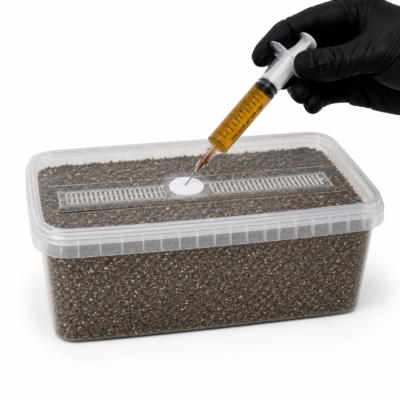
The method is the same for both syringes. Mondo’s manuals for the liquid culture syringe and the spore syringe cover each step with pictures. The steps are:
Both syringes work with Mondo’s sterilised substrate, which has an injection port and is ready to inoculate.
Related products

✓ In stock

✓ In stock
After that, keep the substrate dark and at a steady temperature while it colonizes. If you would rather skip inoculation altogether, a pre-colonized grow kit or ready-to-grow bag is the simpler route: both arrive fully colonized and only need fruiting conditions.
Liquid cultures and spore syringes from Mondo
Every Mondo syringe holds 20 ml and comes with a sterile needle, alcohol swabs and a step-by-step manual. Orders ship discreetly with tracking.
Shop liquid culturesMore questions about liquid culture vs spore syringes
Yes, but not directly in a reliable way. The usual route is to germinate the spores on agar, select a clean and fast-growing section, and transfer that into sterile broth. Adding spores straight to broth works, but you lose the selection step and contamination is harder to spot.
Mondo’s manuals advise injecting the full 20 ml into one substrate. Once a needle has been attached and used, the syringe is no longer sterile, so storing a half-used syringe is a gamble.
For the first inoculation it is the more forgiving choice, because it grows faster and more evenly. Beginners who do not want to inoculate at all are better off with a pre-colonized grow kit.
Spores are microscopic, so 20 ml of spore solution often looks like clear water with a few dark specks. Shake it gently before use to spread the spores evenly through the liquid.
Spores are generally regarded as free of psilocybin, which is one reason their legal status differs from that of mushrooms in many countries. Mycelium can contain the compound, so do not assume a liquid culture falls under the same rules as spores where you live.