







 Strains
 Guides
 Tools
Tools Support





Growing Guides
How to harvest magic mushrooms: twisting, cutting & timing
The difference between a mediocre flush and a great one often comes down to a few seconds of technique at harvest time. Pick too early and you lose potency and yield. Pick too late and spores drop everywhere, weight is wasted on an overgrown cap, and your next flush suffers. This guide covers exactly when to pick, how to pick, and what to do with your mushrooms right after harvesting.
How to know when a mushroom is ready
The single most reliable signal is the veil — the thin membrane connecting the underside of the cap to the stem. While the mushroom is still developing, this veil is intact and the gills underneath are hidden. As the cap matures, the veil stretches and eventually tears away from the stem, exposing the dark gills beneath.
That moment — just as the veil breaks, or just before it does — is the ideal harvest window. Waiting for full veil breakage on every single mushroom isn’t necessary or even advisable: harvesting slightly before full breakage typically preserves more potency, since the mushroom hasn’t yet started dropping spores (which pulls resources away from the cap).
Other signs a flush is ready to harvest:
- Cap edges are still curled slightly inward or just flattening out, not yet turning upward
- The stem has stopped visibly elongating day to day
- Gills are darkening from pale to deep brown/purple-black as spores mature underneath
Mushrooms in the same flush rarely mature at exactly the same time. It’s normal — and recommended — to harvest a flush in two or three passes over several days rather than trying to pick everything at once.
Twist or cut? The two harvesting techniques
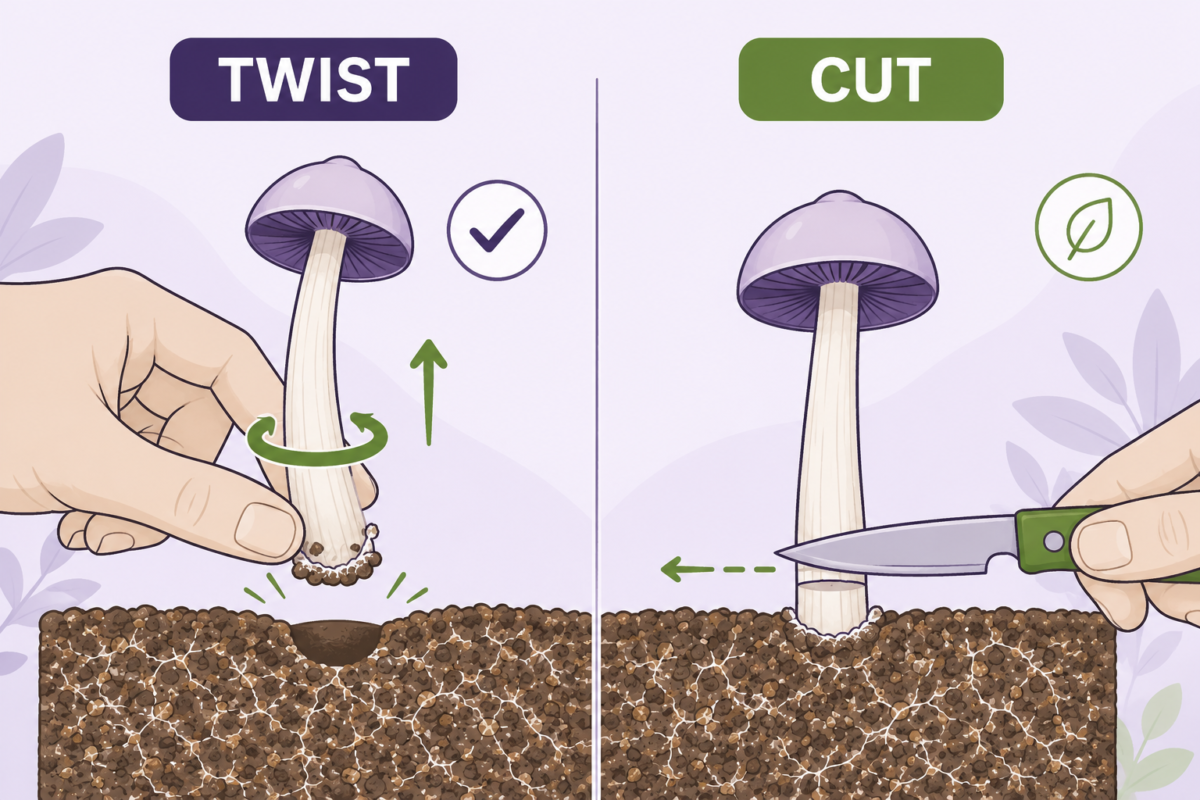
There are two accepted methods for removing a ripe mushroom from the substrate. Both work; which one to use depends on what you’re optimizing for.
Twisting (recommended for most growers)
Grip the stem gently at the base, right where it meets the substrate, and rotate it slowly while pulling upward. Done correctly, the entire mushroom — including the root-like base — comes away cleanly, leaving a small, neat hole in the substrate.
Why growers prefer this method: removing the full stem base eliminates leftover organic matter that would otherwise sit on the substrate and rot, which is one of the most common causes of contamination going into a second flush.
Cutting
Using a clean, sharp knife or scalpel, slice the stem horizontally at substrate level, leaving the small stem base in place.
When this makes sense: if a mushroom is growing in a tight cluster right next to others that aren’t ready yet, twisting risks disturbing or damaging its unripe neighbors. A clean cut lets you remove one mushroom without disrupting the rest of the cluster.
If you cut instead of twist, go back afterward and remove any leftover stem base once the surrounding mushrooms have also been harvested — don’t let it sit and decompose on the substrate.
Harvesting hygienically
Contamination introduced at harvest is one of the most common (and most avoidable) reasons a second flush fails. Before you start picking:
- Wash your hands and forearms thoroughly with soap
- Follow up with a disinfectant hand gel
- Wear clean or sterile gloves
- Use a clean container to collect your harvest — not something that’s been sitting out
- Work in a tidy, clutter-free space
What to do immediately after harvesting
Once picked, mushrooms start losing moisture and potency fairly quickly at room temperature. A few things to do right away:
- Clean up the substrate. Remove any leftover stem bases, broken caps, or debris before setting the kit up for its next flush.
- Sort by size and ripeness. This makes drying more even later, since smaller or less mature mushrooms dry faster than large, dense ones.
- Don’t wash your harvest. Brush off any visible substrate with a soft brush instead — added moisture significantly slows drying and increases the risk of mould during that process.
- Move straight to drying if you’re not consuming fresh. Fresh mushrooms don’t store well and should be dried within a few hours of picking.
Drying your harvest
Drying isn’t optional if you want your harvest to last — fresh mushrooms spoil within a day or two at room temperature. For the full walkthrough on drying methods, target moisture levels, and safe storage, see our guide to drying magic mushrooms.
Frequently Asked Question Harvesting Magic Mushrooms
Twisting is generally preferred because it removes the full stem base, reducing leftover debris that can cause contamination. Cutting is useful for picking individual mushrooms out of a tight cluster without disturbing others nearby.
Watch the veil under the cap. The ideal harvest window is right as the veil starts to tear away from the stem, exposing the gills — not before, and not long after.
Once the veil fully breaks and spores start dropping, the mushroom puts less energy into the cap and more into reproduction, which can reduce potency and creates a mess of spore print wherever it lands.
No. Brush off substrate with a soft brush instead. Washing adds moisture that slows drying and increases the risk of mould.
Not usually. Mushrooms in the same flush mature at slightly different rates, so it’s normal to harvest in two or three passes over several days rather than picking everything in one go.