






 Strains
 Guides
 Tools
Tools Support





Avery’s Albino (Psilocybe cubensis) Strain
Avery’s Albino is a distinctive Psilocybe cubensis strain best known for its almost completely white mushrooms, pale caps and unusual appearance. Among the many cubensis varieties available today, few are as instantly recognizable as Avery’s Albino.
The strain is commonly associated with Cambodian Psilocybe cubensis genetics, although its exact breeding history has never been formally documented. Over time, growers have selected the pale characteristics that give Avery’s Albino its characteristic ghost-white appearance.
Besides its unusual coloration, Avery’s Albino has developed a reputation for a visual and energetic psychedelic character. Potency can vary considerably between individual grows, flushes and genetics, so it should not be assumed that every Avery’s Albino mushroom has exactly the same strength.
Its unusual morphology makes Avery’s Albino particularly interesting to cultivators who have already grown more traditional brown-capped cubensis strains such as Golden Teacher, B+ or McKennaii.
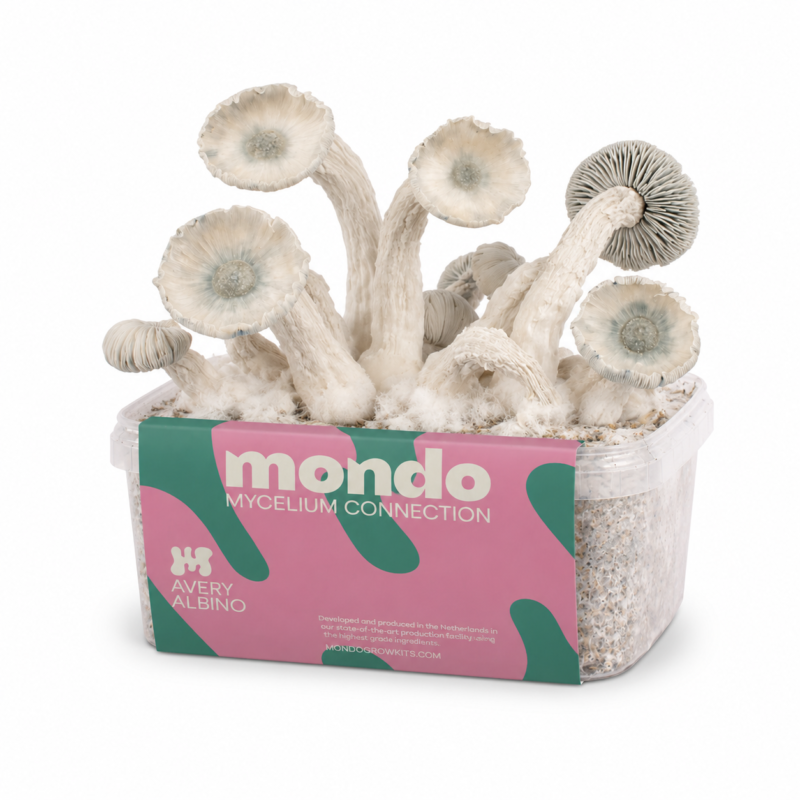
Avery’s Albino Strain Profile
| Property | Rating |
|---|---|
| Potency | ⭐⭐⭐⭐☆ |
| Visual Effects | ⭐⭐⭐⭐☆ |
| Introspective Experience | ⭐⭐⭐⭐☆ |
| Beginner Friendly | ⭐⭐⭐☆☆ |
| Growing Difficulty | ⭐⭐⭐☆☆ |
| Yield Potential | ⭐⭐⭐⭐☆ |
Quick Strain Facts
| Property | Details |
|---|---|
| Species | Psilocybe cubensis |
| Strain | Avery’s Albino |
| Potency | Medium to High |
| Difficulty | Intermediate |
| Genetic Lineage | Often associated with Cambodian cubensis genetics |
| Appearance | White to cream fruiting bodies |
| Bruising | Blue to blue-grey |
| Species Type | Psilocybin-containing mushroom |
What Does Avery’s Albino Look Like?
The appearance of Avery’s Albino mushrooms is what separates this variety from most classic Psilocybe cubensis strains.
Instead of the caramel, tan or golden caps normally associated with cubensis mushrooms, Avery’s Albino typically develops very pale cream to white fruiting bodies. Mature mushrooms can sometimes appear almost translucent under bright light.
Cap
- Color: white, ivory or very pale cream
- Shape: rounded to convex when young
- Often becomes flatter as the mushroom matures
- Can develop subtle blue-grey coloration after bruising
Stem
- White to pale cream
- Usually relatively straight and slender
- Can become thicker toward the base
- May bruise blue when handled or damaged
Spores
Avery’s Albino is particularly interesting from a genetics and microscopy perspective because pale mushroom varieties can show unusual pigmentation characteristics compared with traditional cubensis strains.
This also means that identifying maturity purely by looking for the dark coloration normally associated with a classic cubensis spore drop can be less straightforward.
Is Avery’s Albino Really an Albino Mushroom?
The terminology surrounding albino mushroom strains can be confusing.
In mycology, albino and leucistic are not necessarily the same thing. Albino organisms lack pigment more completely, while leucistic varieties may retain pigmentation in certain structures.
Avery’s Albino is widely sold and cultivated under the albino name, but descriptions of its exact pigmentation characteristics vary between different genetic lines. For that reason, it is more useful for growers to recognize Avery’s Albino by its characteristic extremely pale fruiting bodies rather than relying only on the albino label.
Avery’s Albino Potency and Effects
Avery’s Albino potency is generally described as medium to high for a Psilocybe cubensis variety, although there is no fixed potency level that applies to every mushroom carrying the Avery’s Albino name.
Psilocybin and psilocin concentrations can vary between individual mushrooms, genetics, growing conditions and even separate flushes from the same culture.
Reported characteristics associated with Avery’s Albino include:
- enhanced colors and contrast
- geometric visual patterns
- changes in depth and visual perception
- euphoria
- creative thinking
- introspection
- altered perception of time
Individual experiences can differ considerably. Set, setting, personal sensitivity and mushroom potency all influence the nature and intensity of a psychedelic experience.
Avery’s Albino vs Golden Teacher
Avery’s Albino and Golden Teacher both belong to the species Psilocybe cubensis, but they look very different.
| Characteristic | Avery’s Albino | Golden Teacher |
|---|---|---|
| Cap Color | White to pale cream | Golden brown |
| Potency | Medium to High | Medium |
| Appearance | Albino-style / very pale | Classic cubensis |
| Growing Difficulty | Intermediate | Easy |
| Best Known For | White appearance and distinctive genetics | Reliability and beginner-friendly growth |
For growers interested in classic cubensis morphology, Golden Teacher remains one of the best-known options. Avery’s Albino is more attractive to cultivators looking for something visually unusual.
Avery’s Albino vs Albino A+
Avery’s Albino and Albino A+ are sometimes confused because both produce very pale mushrooms. They are, however, regarded as separate cubensis genetic lines.
Albino A+ is associated with the A+ lineage, while Avery’s Albino is commonly linked within cultivation circles to Cambodian genetics.
Both can produce white or cream mushrooms, but fruit shape, cap development and pigmentation can differ considerably depending on the specific culture being grown.
Avery’s Albino vs Albino Penis Envy
Despite their similar pale appearance, Avery’s Albino and Albino Penis Envy are very different varieties.
Albino Penis Envy belongs to the well-known Penis Envy genetic family and is typically associated with unusually dense mushrooms and a reputation for particularly high potency.
Avery’s Albino generally develops a more traditional Psilocybe cubensis mushroom shape, with a clearly defined stem and expanding cap.
| Characteristic | Avery’s Albino | Albino Penis Envy |
|---|---|---|
| Appearance | Pale, classic cubensis shape | Pale, thick and compact |
| Potency | Medium to High | High to Very High |
| Growth | More typical cubensis development | Often slower |
| Genetic Family | Associated with Cambodian lineage | Penis Envy lineage |
Products used here

Growing Avery’s Albino
Avery’s Albino behaves broadly like other Psilocybe cubensis strains, although its pale genetics and fruit development make it particularly interesting for growers with some previous cultivation experience.
Compared with extremely forgiving varieties such as Golden Teacher, Avery’s Albino may require slightly more attention to fruit development and environmental stability.
Its white coloration can also make certain developmental changes less obvious than they are with conventional brown-capped cubensis mushrooms.
Growers interested in exploring different mushroom genetics can view our Psilocybe cubensis genetics, while complete cultures are available in our Magic Mushroom Grow Kits collection.
Avery’s Albino Growth Characteristics
| Characteristic | Typical Profile |
|---|---|
| Growth Speed | Medium |
| Fruiting Style | Clusters and individual mushrooms |
| Mushroom Size | Medium |
| Cap Development | Rounded, expanding with maturity |
| Stem Structure | Slender to moderately thick |
| Yield Potential | Medium to High |
Actual performance depends heavily on the genetic culture and cultivation environment. Two cultures sold under the same strain name can still display noticeable differences in growth speed, morphology and yield.
Avery’s Albino Yield Potential
Avery’s Albino can produce productive flushes when grown under suitable conditions, but exact yields should never be treated as guaranteed.
Final harvest weight is influenced by several factors, including:
- genetics
- substrate volume
- substrate condition
- humidity
- fresh air exchange
- temperature
- stage of harvest
Multiple flushes can be possible from healthy Psilocybe cubensis mycelium. Later flushes may produce fewer mushrooms but sometimes larger individual fruits.
Origin of Avery’s Albino
The precise history of the Avery’s Albino strain is difficult to verify.
Most descriptions within the mushroom cultivation community connect the variety to Cambodian Psilocybe cubensis genetics and describe it as a pale or albino selection that was stabilized through selective cultivation.
Unlike formally registered agricultural cultivars, many Psilocybe cubensis strain names developed within informal cultivation communities. As a result, detailed breeding records are often unavailable.
For that reason, claims about a specific breeder, discovery date or exact genetic ancestry should be treated as community history rather than established scientific fact.
Why Avery’s Albino Is So Popular
Avery’s Albino stands out in a strain collection immediately. Its popularity is driven largely by a combination of unusual appearance and interesting cubensis genetics.
Growers are particularly attracted to Avery’s Albino because of its:
- striking white fruiting bodies
- unusual pigmentation
- classic cubensis mushroom structure
- medium to high potency reputation
- interesting genetic background
- strong visual appeal when fruiting
For cultivators who have already experienced traditional strains such as Golden Teacher or B+, Avery’s Albino offers a noticeably different-looking member of the Psilocybe cubensis strain family.
Avery’s Albino from Mondo
Every Mondo product comes with a step-by-step manual on our site, and orders ship discreetly with tracking.
View the Avery's Albino sporesAvery’s Albino FAQ
Avery’s Albino is a pale Psilocybe cubensis strain known for producing predominantly white or cream-colored mushrooms. It is commonly associated with Cambodian cubensis genetics, although its complete breeding history is not formally documented.
No. Although both strains can produce very pale mushrooms, Avery’s Albino and Albino A+ are separate genetic lines. Albino A+ is associated with the A+ lineage, while Avery’s Albino is commonly linked to Cambodian cubensis genetics.
Avery’s Albino can be cultivated using methods commonly used for Psilocybe cubensis. However, its unusual coloration can make certain stages of mushroom development slightly harder to recognize than with classic strains such as Golden Teacher. For this reason, it is generally considered more suitable for growers with some previous experience.
The characteristic pale appearance of Avery’s Albino is caused by genetics affecting pigmentation. The mushrooms typically develop white to cream-colored fruiting bodies rather than the golden or caramel-colored caps commonly associated with Psilocybe cubensis.
Yes. Avery’s Albino mushrooms can develop blue or blue-grey bruising when the mushroom tissue is damaged. Because the fruiting bodies are so pale, this discoloration can be particularly noticeable.
Avery’s Albino is generally regarded as a medium to high potency Psilocybe cubensis variety. Actual potency can vary considerably between genetics, individual mushrooms and separate harvests.