






 Strains
 Guides
 Tools
Tools Support





Magic Truffles
How to Grow Magic Truffles: From Liquid Culture to Sclerotia
This is how to grow magic truffles: you inoculate a sterile, nutrient-rich substrate with a truffle-forming species such as Psilocybe tampanensis or Psilocybe mexicana and then leave it in the dark for months. The truffles are sclerotia: hard knots of mycelium that form inside the substrate rather than mushrooms on top of it. Expect roughly three to four months, often longer, before they are ready.
What is a magic truffle?
A magic truffle is a sclerotium, a compact mass of hardened mycelium that some Psilocybe species form as a food and survival store. In nature it helps the fungus survive drought or fire underground. It is not related to the culinary truffles of the genus Tuber; the word “truffle” only describes the look.
Only a few psilocybin species form sclerotia reliably. Psilocybe cubensis, the species in most grow kits, does not. The species most often grown for truffles are:
| Species | Known for | Mondo culture |
|---|---|---|
| Psilocybe tampanensis | Found near Tampa, Florida in 1977; small, rounded truffles | Tampanensis liquid culture |
| Psilocybe mexicana | Native to Mexico and Central America; the species behind most “Mexicana” truffles | Mexicana liquid culture |
| Psilocybe galindoi | Described from Mexico; grown mainly for its sclerotia | Galindoi liquid culture |
| Selections such as Atlantis, Utopia, Hollandia and Pajaritos | Cultivated lines of truffle-forming species | Each available as liquid culture |
How is growing truffles different from growing mushrooms?
Growing truffles is mostly a matter of waiting in the dark, while growing mushrooms is mostly a matter of managing light, humidity and fresh air. The two processes start the same way and then go in opposite directions.
- Mushrooms need the colonized substrate to be exposed to light and fresh air so it starts fruiting.
- Truffles form when the substrate stays closed, dark and undisturbed for a long time after colonization.
That makes truffle cultivation simpler in daily care but longer and less forgiving of contamination. A bag that sits for twelve weeks has twelve weeks in which any weak spot in your sterile work can show up.
How do you grow magic truffles step by step?
Products used here
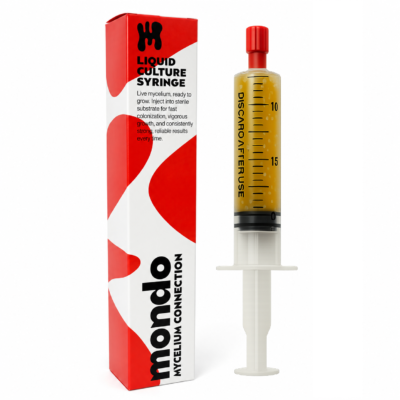
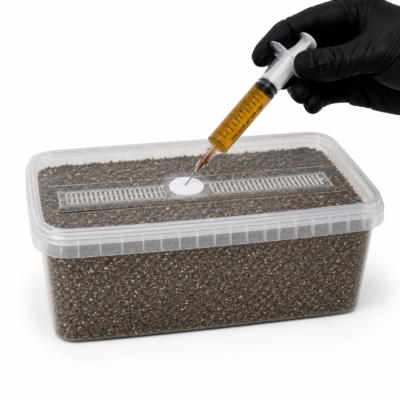
Use liquid culture for truffles
Truffle cultivation is long enough already. A liquid culture skips the germination stage of spores, so colonization starts right away. Our comparison of liquid culture vs spore syringe explains why that matters.
How do you know your truffles are developing well?
Healthy truffle development shows as white mycelium followed by small, firm knots that turn from white to light brown. The bag should smell earthy or of fresh mushrooms.
Warning signs are the same as for any mushroom substrate: green, black, pink or orange patches, slimy wet spots, or a sour or rotten smell. Our guide to contamination shows what these look like. A bag with clear contamination will not recover and should not be opened indoors; seal it in a plastic bag and dispose of it.
Why do some truffle bags produce mushrooms?
Truffle species can still fruit mushrooms when a colonized bag gets light, fresh air or a temperature drop. Small mushrooms appearing on top of the substrate are not a sign of failure, but they do mean the bag is getting signals that favor fruiting. Move the bag to a darker, more stable spot if you want to keep the energy going into sclerotia.
What do you do with truffles after harvest?
Fresh truffles keep best in the fridge, dry and sealed from the air. Our article on how to store magic truffles explains shelf life, the paper-towel method and how to recognize spoilage.
Check the law where you live
In the Netherlands fresh magic truffles are not covered by the Opium Act, but that is an exception. In many countries both growing and possessing truffles is illegal. Check the rules in your own country before you start.
Truffle liquid cultures from Mondo
Every Mondo product comes with a step-by-step manual on our site, and orders ship discreetly with tracking.
Shop truffle liquid culturesQuestions about growing magic truffles
No. Psilocybe cubensis does not form sclerotia. You need a truffle-forming species such as tampanensis, mexicana or galindoi.
Count on roughly three to four months from inoculation to harvest, and sometimes longer. Colonization is the first few weeks; most of the time goes into forming and maturing the sclerotia.
No. Truffles form best in the dark. Light is a signal for mushroom fruiting, which is the opposite of what you want here.
It is not recommended. The nutrients are largely used up and opened substrate is exposed to contaminants. Start a new bag for the next batch.
Mexicana and tampanensis are the most widely grown and well documented. Both are good choices for a first truffle grow.