






 Strains
 Guides
 Tools
 Support


Troubleshooting
Why Are My Mushrooms Long and Thin? Leggy Stems Explained
If you are asking why are my mushrooms long and thin, the answer in most grow kits is too little fresh air: carbon dioxide builds up inside the bag and the mushrooms stretch their stems to reach better air. Too little light can cause a similar look. Both are easy to fix during the current flush, and the mushrooms themselves are not harmed.
What do “leggy” mushrooms look like?
Leggy mushrooms have stems that are much longer than normal for the strain, often thin and sometimes bent, with small caps that open early. In a typical case you see:
- stems two or three times as tall as the caps are wide;
- small, narrow caps on top;
- mushrooms leaning in one direction, often toward the light or the filter patch;
- caps that open while the mushroom is still thin.
Some strains naturally grow taller than others, so compare with what is normal for your strain. McKennaii, for example, grows taller than Golden Teacher by nature. Thin and stretched is the warning sign, not tall alone.
Why do mushrooms grow long and thin?
Mushrooms grow long and thin when they are looking for something. In the wild, a mushroom has to push its cap up into open air to release spores. High carbon dioxide or darkness tells it that it has not reached open air yet, so it keeps stretching the stem instead of developing the cap.
| Cause | How to recognize it | Fix |
|---|---|---|
| Too little fresh air (high CO2) | Long, thin stems; small caps; whole flush affected | Air the bag 1 to 3 times a day, briefly |
| Too little light | Stems lean toward the light source; pale caps | Move to a brighter spot with indirect light or add an LED |
| Too warm | Fast, weak growth; caps open early | Bring the kit back to 23 to 25 °C |
| Strain trait | Tall but sturdy mushrooms, normal caps | Nothing; that is how the strain grows |
How do you fix long, thin stems?
Fix leggy stems by improving fresh air first, then light. Change one thing at a time so you can see what worked.
You will usually see the effect on new growth within a day or two. Mushrooms that are already stretched will not shorten, but their caps can still develop normally.
Products used here



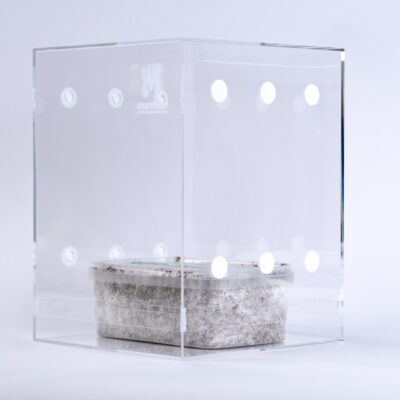


Do not over-correct
Leaving the bag open for hours to “give it lots of air” dries the surface and causes aborted pins. Short, regular air exchange works better than one long airing. See our guide to aborted mushroom pins if pins start to darken.
Are long, thin mushrooms bad?
No. Long, thin mushrooms are a cosmetic and yield issue, not a health issue for the kit. The flush may weigh a little less because energy went into stems rather than caps, and very thin mushrooms can fall over. The kit itself is fine and can produce a normal next flush once the conditions are adjusted.
Harvest them as usual, when the veil under the cap starts to tear. With leggy mushrooms that moment can come earlier, so check the caps rather than waiting for the mushrooms to reach a certain height. Our guide on how to harvest magic mushrooms shows how.
How do you prevent it in the next flush?
Prevent leggy mushrooms by starting the fresh-air routine as soon as the first pins appear, not when the mushrooms are already tall. Combine that with a bright spot and a stable temperature. The balance between humidity and fresh air is explained in our guide to fruiting conditions.
If you grow kit after kit, a grow box with filter patches makes air exchange more even. Our article on the magic mushroom grow box explains when that is worth it.
Better fruiting conditions with Mondo
Every Mondo product comes with a step-by-step manual on our site, and orders ship discreetly with tracking.
Shop grow toolsQuestions about long, thin mushrooms
Humidity itself rarely causes long stems. The usual cause is that a very closed, humid bag also has little fresh air. Fix the air exchange and keep the humidity.
They grow toward the light or toward the filter patch where the air is freshest. Turning the kit a quarter turn each day can give more even growth.
Light helps the mushrooms orient themselves and develop caps, but it does not replace fresh air. Use both.
Yes. Penis Envy grows dense, thick stems with small caps by nature, which is the opposite of leggy growth.
Not if you adjust the air exchange and light. Each flush responds to the conditions at the time it forms.