






 Strains
 Guides
 Tools
 Support


Magic Truffles
Psilocybe tampanensis: The Rare Species Behind Philosopher’s Stones
Psilocybe tampanensis is a small psilocybin mushroom that forms sclerotia, the dense structures sold as magic truffles or “philosopher’s stones”. It was found in 1977 by mycologist Steven Pollock in a sandy meadow near Tampa, Florida, and described by Gastón Guzmán and Pollock in 1978. Most tampanensis in cultivation is said to trace back to that single find.
Where does Psilocybe tampanensis come from?
Psilocybe tampanensis comes from the southeastern United States. Pollock collected one specimen near Tampa in 1977, and for almost twenty years that remained the only known wild collection. A second find was reported from Mississippi in 1996. The species is still rarely seen in the wild.
The original specimen was cultured, and the culture was shared and propagated. That is unusual: most strains in cultivation come from many wild collections, while tampanensis largely descends from one.
What does Psilocybe tampanensis look like?
Psilocybe tampanensis is a small, delicate mushroom, nothing like the sturdy cubensis in most grow kits.
| Psilocybe tampanensis | Psilocybe cubensis | |
|---|---|---|
| Cap | 1 to 2.4 cm, yellowish brown, convex to conical | 2 to 10 cm depending on strain |
| Habitat | Sandy meadows near deciduous forest | Dung and rich soils in warm climates |
| Spore print | Purple-brown | Dark purple to black |
| Sclerotia | Yes | No |
| Grown mainly for | Truffles | Mushrooms |
Why does tampanensis form truffles?
Tampanensis forms sclerotia because its mycelium stores food in compact, hardened knots below ground. In a sandy habitat that dries out and heats up, such a store lets the fungus survive periods that would kill exposed mycelium. When conditions improve, mushrooms can grow from the stored reserves.
In cultivation this trait is the whole point. Growers keep inoculated substrate closed and dark for months, so the mycelium puts its energy into sclerotia instead of mushrooms. Our guide on how to grow magic truffles describes that process step by step.
Products used here
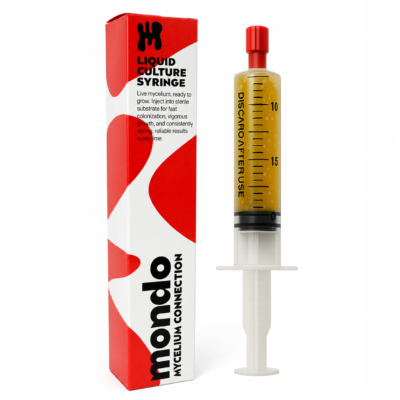
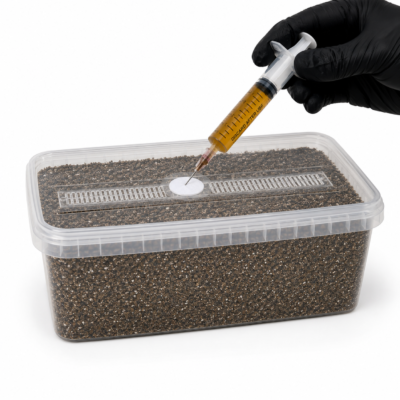


✓ In stock

✓ In stock

How is Psilocybe tampanensis cultivated?
Tampanensis is cultivated almost entirely from cultures, not from wild spores. The usual route is:
A liquid culture is the practical choice here. Wild spores are scarce, and starting from a culture that already forms sclerotia saves months of selection work. Our comparison of liquid culture vs spore syringe explains the difference in more detail.
Patience pays off with tampanensis
A truffle bag looks unchanged for weeks once colonization is done. That is normal. Opening it to check is the most common way to introduce contamination into an otherwise healthy bag.
How does tampanensis compare to other truffle species?
Tampanensis is one of several species grown for truffles. The most common alternatives are Psilocybe mexicana, native to Mexico and Central America, and Psilocybe galindoi. Commercial truffle names such as Atlantis, Utopia, Hollandia and Pajaritos are cultivated lines of these truffle-forming species.
The differences that matter to a grower are mostly practical: how fast a line colonizes, how large and firm the truffles become and how many form per bag. Those depend on the specific culture as much as on the species.
Is Psilocybe tampanensis legal?
The legal status depends entirely on the country. In the Netherlands fresh truffles are not covered by the Opium Act, which is why they can be sold there. Our guide on how to store magic truffles covers what to do with fresh truffles once you have them. In many other countries, sclerotia and the mushrooms themselves are controlled substances, and growing them is illegal.
Tampanensis from Mondo
Every Mondo product comes with a step-by-step manual on our site, and orders ship discreetly with tracking.
View the Tampanensis liquid cultureQuestions about Psilocybe tampanensis
It is a trade name that became popular for tampanensis sclerotia. It refers to their stone-like look and has no botanical meaning.
Yes. Given light, fresh air and the right moisture, tampanensis can fruit small mushrooms. In truffle cultivation growers avoid those conditions.
No. They are related species with a similar ability to form sclerotia, but mexicana is native to Mexico and Central America and was described in 1957.
Size varies with the culture and the substrate. Most are irregular, nut-sized pieces rather than large single truffles.
It is part of Mondo’s magic truffle liquid culture range, together with Mexicana, Atlantis, Galindoi, Hollandia, Utopia and Pajaritos.