




 Strains
 Guides
 Tools
 Support


Troubleshooting
How to Tell If Liquid Culture Is Contaminated
How to tell if liquid culture is contaminated comes down to four checks: the liquid should be clear, the mycelium white, the smell neutral and the growth should look like strands or clumps rather than a film. Cloudy liquid usually means bacteria; colored specks or fuzzy growth on the surface usually mean mold. If any of those show, do not inject the culture.
What does healthy liquid culture look like?
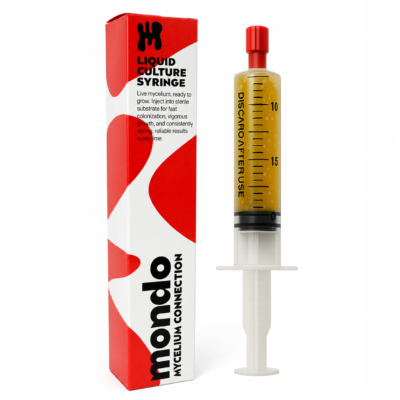
Healthy liquid culture is a clear liquid with white to off-white mycelium floating in it. The mycelium can look like:
- small cotton-like clumps that drift when you tilt the syringe;
- thin strands or a loose cloud of threads;
- one larger mass that breaks up when you shake it gently.
The liquid between the mycelium stays transparent. It can have a light yellow or amber tint, depending on the broth, but it should not be milky.
Which signs point to contamination?
Cloudiness, color, smell and a film or fuzzy growth are the warning signs. One of them is enough reason not to use the culture.
| What you see | Likely cause | What to do |
|---|---|---|
| Milky or cloudy liquid that does not clear after resting | Bacteria | Do not use |
| Fuzzy balls or colored growth, often at the liquid surface | Mold | Do not use |
| Pink, orange or red tint | Bacteria or yeast | Do not use |
| Slimy film on the surface or along the wall | Bacteria | Do not use |
| Sour, rotten or vinegar smell at the tip | Bacteria or yeast | Do not use |
| Clear liquid, white clumps | Healthy mycelium | Use as normal |
| Clear liquid, one dense white mass | Healthy mycelium that grew together | Shake gently, let it warm up, then use |
Do not test by injecting
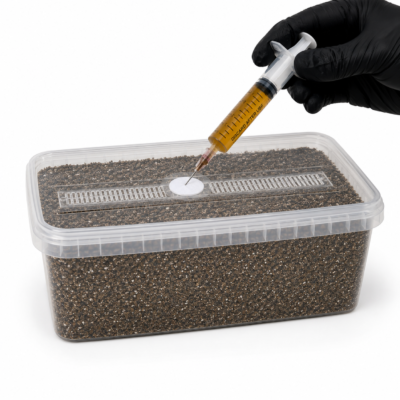
Injecting a suspicious culture “to see what happens” costs you a whole bag of substrate and can spread spores of mold in your work area. When in doubt, stop and contact support with clear photos.
How do you check a syringe properly?
Apart from the warm-up, the check takes two minutes.
Products used here
✓ In stock
What changes are normal and harmless?
Several things look strange but are not contamination:
- Mycelium clumped at the bottom. In a still liquid, mycelium settles. Shaking breaks it up again.
- A denser look after weeks in the fridge. The mycelium keeps growing very slowly in the cold.
- A few tiny air bubbles. These come from handling and transport. Bubbles that keep forming after the syringe has rested, or foam, are a warning sign.
- A slight color difference between strains. Some broths and strains give a warmer tint to the liquid. What matters is that it is clear.
How does contamination get into a liquid culture?
Contamination gets in at three moments: during production, during transport and storage, or during your own handling. Mondo prepares each culture from a Petri dish, selects clean growth and checks each batch before it goes into syringes. After that, the risk shifts to what happens on the way and in your home.
- Heat. A parcel left in a hot car or hallway can let a small number of bacteria multiply.
- Opening the tip. Removing the cap, touching the tip or leaving it open while you prepare the substrate exposes the culture.
- Re-using a syringe. A syringe that has been used and stored again is no longer sterile.
Our guide on how to store liquid culture covers the storage side in detail.
What if the substrate gets contaminated after injecting?
If the culture looked clean and the substrate still turns green or smells sour after injection, the cause is more often in the inoculation step than in the culture. Check the cleaning steps: hands, surface, syringe tip, needle and injection port. Our guide to grow kit contamination shows how to tell mold from bruising and harmless metabolites in the substrate, and our liquid culture vs spore syringe comparison explains why problems show more clearly in liquid culture than in spore solutions.
Related products

✓ In stock
Lab-checked liquid cultures from Mondo
Every Mondo syringe holds 20 ml and comes with a sterile needle, alcohol swabs and a step-by-step manual. Orders ship discreetly with tracking.
Shop liquid culturesQuestions about liquid culture contamination
Not reliably at home. Separating mycelium from bacteria requires agar work and a sterile setup. For most growers it is better to replace the culture.
Yes. Leave the closed syringe at room temperature for about 24 hours and check again. Contamination that was slowed down by the cold often becomes visible in that time.
Shake the syringe gently and look again against a light source; small strands can be hard to see. If the liquid is clear and you see nothing after shaking, contact support with a photo.
Cold slows contamination down, so it may become visible only after the syringe has been at room temperature for a while. That is one reason to check the syringe after it has warmed up.
Yes. Send your order number and clear photos to Mondo support before you use or discard the syringe.