






 Strains
 Guides
 Tools
 Support






Growing Guides
Why Do Magic Mushrooms Turn Blue When You Touch Them?
Magic mushrooms turn blue because damage to the tissue sets off an enzyme reaction: psilocybin is converted into psilocin, and psilocin is then oxidized and linked into blue compounds. Researchers at the Leibniz Institute (Hans Knöll Institute) in Jena described this two-enzyme reaction in Psilocybe cubensis in 2019. Blue bruising is normal, harmless to the grow and not a sign of contamination.
What happens chemically when a mushroom bruises blue?
Bruising is a two-step reaction that starts when cells are damaged by touch, pressure or cutting:
In an intact mushroom the enzymes and psilocybin are kept apart. Damage mixes them, which is why the blue appears exactly where the mushroom was pressed, pinched or cut. The research was published by Lenz and colleagues in Angewandte Chemie.
Where do you see bruising on a grow kit?
You see bruising wherever the mushroom or mycelium has been touched or stressed. Typical places:
- the base of the stem where you twisted a mushroom loose;
- spots where a cap pressed against the grow bag;
- the cut surface after harvesting;
- patches of mycelium on the substrate that were touched, pressed or dried out.
Some strains show it much more than others. Albino and leucistic strains such as True Albino Teacher and Jack Frost show strong blue tones because the contrast with the white tissue is so high. Penis Envy is also known for pronounced bruising.
Is blue on the substrate mold or bruising?
Blue on the substrate is usually bruising, but blue-green can be mold. The difference is in color, texture and how it changes.
| Bruising | Blue-green mold (for example Penicillium) | |
|---|---|---|
| Color | Deep blue to blue-black, sometimes with a purplish tint | Blue-green to grey-green, often with a white edge |
| Texture | Same texture as the surrounding mycelium or tissue | Powdery or dusty surface |
| Where | Where the kit was touched, pressed or dried | Anywhere, often spreading in a circle |
| Over time | Stays the same size or fades | Grows larger day by day |
When in doubt, take a sharp photo and look again in 24 hours. Bruising does not spread. Mold does. Our guide to contamination shows the common molds side by side.
Handle mushrooms by the base
Twist mushrooms off at the base of the stem with clean hands and touch the caps as little as possible. You will still see some blue at the base, but less on the rest of the mushroom.
Products used here
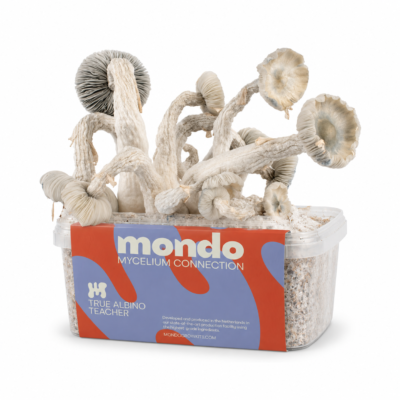
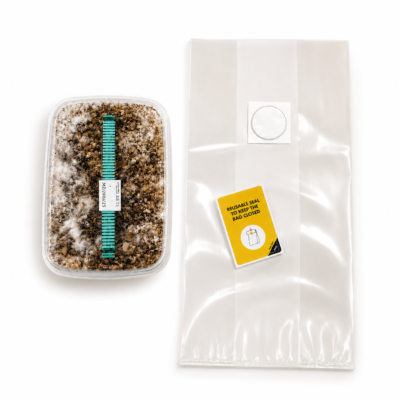
✓ In stock
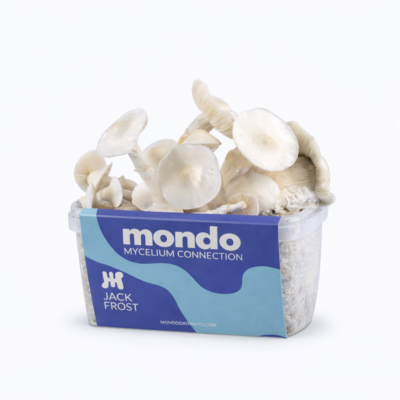
✓ In stock
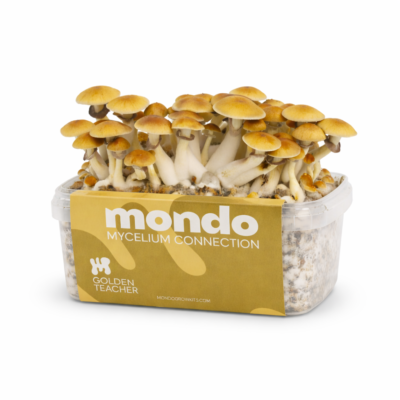
✓ In stock
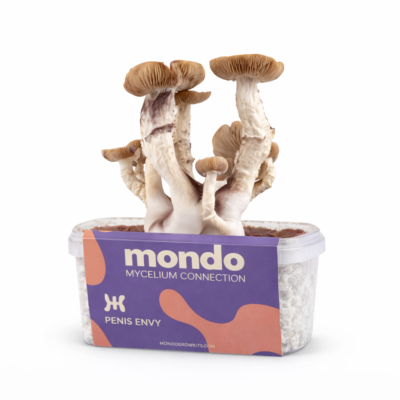
✓ In stock
Does bruising damage the grow kit?
No. Bruising on the mycelium is a local reaction to damage or stress and does not spread through the kit. A kit with blue patches on the surface can fruit normally. Blue patches on the substrate can, however, tell you something about the conditions: mycelium that dried out or was handled a lot will often show blue first. If you see bruising on the surface before pins have formed, check whether the bag is too dry or whether the kit has been opened more than the manual advises.
Bruising also shows up during and after a flush, around the spots where mushrooms were harvested. That is normal, and the kit can still produce a second flush.
Do all psilocybin mushrooms bruise blue?
Most psilocybin-containing Psilocybe species bruise blue, but how strongly varies a lot between species and strains. Some species, such as Psilocybe azurescens, are known for very intense bruising. Others show only faint blue tones. Bruising is a useful field sign for mycologists, but it is not proof that a mushroom contains psilocybin, and it is never a safe way to identify a wild mushroom.
Never identify wild mushrooms by color
Several poisonous mushrooms look similar to psilocybin species, and some non-psilocybin mushrooms also change color when damaged. Do not pick or eat wild mushrooms based on bruising.
Grow your own cubensis with Mondo
Every Mondo product comes with a step-by-step manual on our site, and orders ship discreetly with tracking.
Shop grow kitsQuestions about blue bruising
Mycelium bruises when it is pressed, touched or dried out. Check whether the bag is drying out and avoid touching the surface. If the blue does not spread and the rest stays white, the kit is usually fine.
No. Bruising starts within minutes of handling and is not a sign of spoilage. Fresh mushrooms go bad by becoming soft, slimy or smelly, not by turning blue.
They bruise the same way, but the blue shows more clearly against white tissue than against brown caps.
Not entirely. Every harvest damages some tissue. Clean hands, a gentle twist at the base and as little handling as possible keep it to a minimum.
Clear or yellowish droplets are normal metabolites. Green, cloudy or foul-smelling liquid is a different matter and points to contamination; check the kit against our contamination guide.